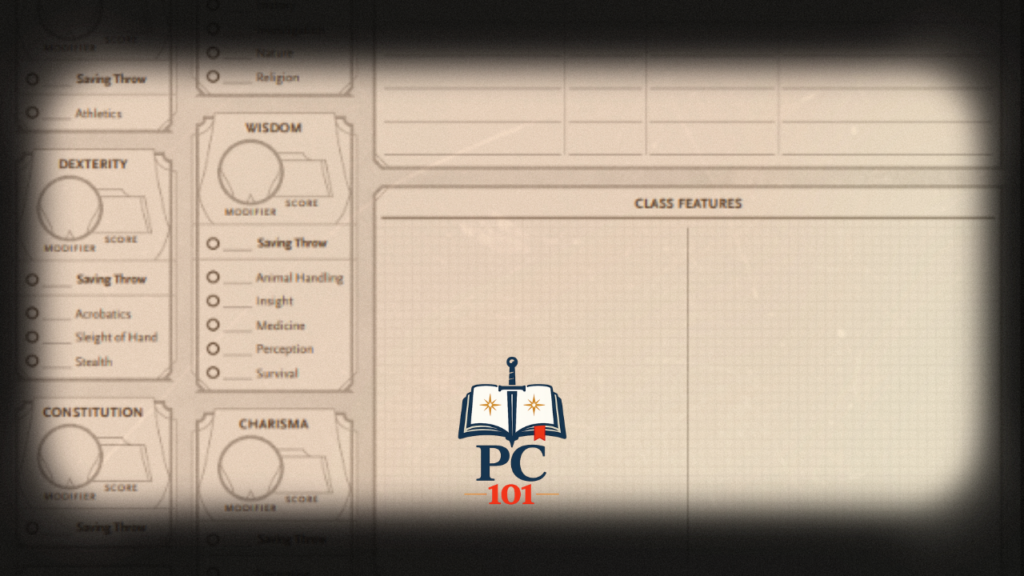
PC 101 · LESSON ONE
Your character sheet is a dashboard not a test.
Ability scores. Saving throws. Armor Class. Hit Dice. Proficiency. Spell slots. Attack bonuses. The character sheet places nearly everything about your D&D character in front of you at once, then quietly expects you to know which number matters now.
PC 101: Your Character Sheet is a free introductory ebook that teaches you how to navigate that information. The goal is not to memorize every rule. It is to understand what the major sections tell you, where to look when the Dungeon Master asks for a roll, and how the numbers connect to what your character does in the story.
THE REAL DIFFICULTY
The numbers are not the hard part. Finding the right one is.
No single box on a character sheet is especially complicated. The trouble comes from density. A saving throw may look like a skill modifier. An attack bonus sits beside damage dice even though they answer different questions. Your raw ability score is printed more prominently than the modifier you will usually roll.
That creates a predictable new-player experience: the Dungeon Master asks for an Investigation check, an enemy attacks, or your turn begins—and you start scanning the entire page. The sheet contains the answer, but it does not automatically teach you how to retrieve it.
Character-sheet fluency means knowing where to look—not remembering everything without looking.
Once the page has a structure in your mind, it stops looking like a wall of statistics. It becomes a control panel: part identity record, part health display, part action menu, and part resource tracker.
THE BASIC PATTERN
Find. Roll. Add. Report.
Many D&D mechanics use the same four-step loop. Learning that loop gives you a reliable starting point even when the name of the roll changes.
1. Find
Locate the requested skill, saving throw, attack bonus, or ability modifier.
2. Roll
Roll the d20 unless the rule specifically asks for another die.
3. Add
Add the modifier printed beside that specific entry.
4. Report
Give the total, not just the number showing on the die, to the Dungeon Master.
Not every rule follows this pattern. Damage rolls, healing, Hit Dice, and some class features use different dice or no d20 at all. But the loop handles a large share of the moments when a new player is asked, “What did you get?”
THE DASHBOARD
Four questions organize most of the sheet
What am I good at?
Ability modifiers, skills, saving throws, and proficiency describe the tasks your character handles well and the weaknesses that may put them under pressure.
Look here when: the GM asks for a check or saving throw, or you propose something uncertain outside combat.
How hard am I to hurt?
Armor Class, Hit Points, temporary hit points, Hit Dice, and Death Saves describe your current condition and your ability to endure danger.
Look here when: an enemy attacks, you take damage, you rest, or your character falls unconscious.
What can I do?
Weapons, spells, class features, species traits, feats, equipment, speed, and initiative form your menu of possible actions and advantages.
Look here when: your turn begins, you are choosing an approach, or another rule triggers one of your features.
What do I have left?
Spell slots, ammunition, limited-use features, conditions, equipment, and other tracked resources tell you which options remain available.
Look here when: you spend a resource, finish a rest, or need to know whether a powerful option is still ready.
COMMON CONFUSION
Similar numbers can do different jobs
Score vs. modifier
Your Strength score may be 16, but the modifier used for most Strength rolls is +3. The larger number defines the ability; the smaller signed number usually enters the calculation.
Attack vs. damage
The attack roll determines whether you hit. The damage roll determines how much harm a successful hit causes. They often use different dice and different modifiers.
Spell attack vs. save DC
Some spells ask you to make an attack roll. Others force the target to roll against your Spell Save DC. The spell description tells you which method applies.
Read the label before trusting the number
Two entries can happen to show the same value while representing different rules. Do not rely on remembering “I add five.” Learn whether that five is your Perception modifier, attack bonus, saving throw, or something else. The label preserves the logic when your character levels up and the numbers change.
WHAT THE EBOOK PROVIDES
A guided tour of the information you actually use
Lesson One walks through ability scores and modifiers, skills and saving throws, Armor Class and Hit Points, proficiency and initiative, weapons and damage, spellcasting, class features, species traits, feats, equipment, and the other information that defines your character.
It also provides practical examples of common checks, attack rolls, damage rolls, and spell mechanics. The point is not to transform a new player into a rules encyclopedia. It is to build enough familiarity that the sheet supports play instead of interrupting it.
Begin with Lesson One
If the sheet still feels like an undifferentiated page of boxes, start here. Learn where the information lives and what each major number is for.
Continue with Lesson Two
Once you can find your abilities, turn them into plans. PC 101: Building Your Character Playbook helps you decide when those options are useful.
BEFORE YOUR NEXT SESSION
Spend ten minutes learning where your answers live
Find your best skill, your weakest saving throw, your Armor Class, your most common attack bonus, and one limited resource. You do not need the whole sheet at once. You need a few dependable landmarks.
A Player Education resource from the Guild of Lost Lore · The Stygian Labyrinth
Discover more from The Stygian Labyrinth
Subscribe to get the latest posts sent to your email.