What 47 concluded, abandoned, or paused campaigns can—and cannot—tell us about building a campaign that reaches an ending
In June 2026, we set out to collect data in a survey relating to campaign reliability. 110 people filled out the survey answering questions regarding the state of their campaigns. We were looking for commonalities as to why campaigns fail to conclude and what makes other games so resilient.
What we did not account for in the survey were a lot of personal factors such as age and relationships. Anecdotal evidence pointed to relationship breakups and general adult responsibilities as a large factor in why campaigns came to inglorious endings. We also didn’t account for the fact some GMs really wanted to brag about the longevity of their campaigns but we ran into the Ship of Theseus paradox. Is a campaign that started with one set of players and ends with a completely different set of characters the same campaign? We’ll leave that for others to debate.
The most resilient campaign in this survey was not the smallest or the most tightly scheduled. The strongest observed structure used five regular players, met weekly or every other week, and kept playing when one player was absent. Longer story arcs performed better than short fixed runs, while moderate GM preparation and mixed-familiarity groups also appeared frequently among campaigns that concluded.
Campaigns usually do not die because the story was too ambitious
They die because the group cannot keep putting people around the table. Scheduling pressure, absences, changes in work or family life, and GM fatigue steadily erode momentum. A resilient campaign is therefore not one protected from disruption. It is one structured to absorb ordinary disruption without losing the habit of play.
That distinction matters. Reliability is not the same as creative quality, and resilience is not a promise that a campaign will finish. It describes whether the campaign can continue functioning when normal problems occur.
What the survey measured
The survey contained 110 responses. Because the question here is what distinguishes campaigns that reach an ending, the 63 campaigns that were still active were excluded. That left 47 non-active campaigns: 35 completed with an intended ending, eight abandoned without resolution, and four paused. The observed completion rate within this comparison group was 74.5%.
These are respondent-level survey results, not a representative census of tabletop campaigns. The analysis reports observed counts and rates only. It does not claim causation, and categories represented by only a handful of campaigns are identified as such rather than treated as general rules.
The strongest observed campaign structure
Taken component by component, the survey points toward the following practical structure:
- Five regular players, not counting the GM.
- A weekly or every-other-week meeting rhythm.
- An explicit expectation that the game can continue when one player is absent.
- A longer story arc rather than a short, tightly fixed session count.
- Roughly one to two hours of GM preparation per session.
- A group containing a mixture of existing relationships rather than one composed entirely of close friends or entirely of strangers.
These elements were not tested as a single bundled formula. No meaningful number of campaigns in the data matched every characteristic simultaneously. This is therefore a component-level model: each element describes one of the strongest observed categories for that variable.
Five players provided the strongest buffer
Five-player campaigns produced the highest completion rate among the player counts with a usable number of responses: 16 of 19 concluded, or 84.2%. Four-player campaigns concluded in 13 of 17 cases, while three-player campaigns concluded in three of four.
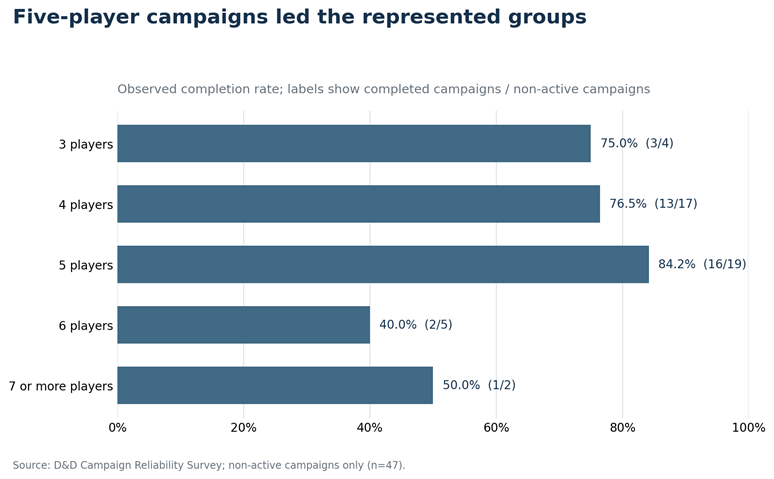
The five-player result fits the operational problem the survey exposes. A five-player roster can lose one person and still put four players at the table. The survey proves the completion rate, not the mechanism; the buffer interpretation should be treated as a practical reading of the structure rather than a demonstrated cause.
The results for six players and seven or more were lower, but those categories contained only five and two campaigns respectively. The data supports five as the strongest observed count. It does not establish that adding a sixth player causes campaigns to fail.
Weekly and biweekly campaigns performed equally well
The survey does not support the common assumption that weekly play is uniquely necessary. Weekly and every-other-week campaigns both recorded an 83.3% completion rate. Monthly campaigns completed in three of six cases, while irregular campaigns completed in two of five.
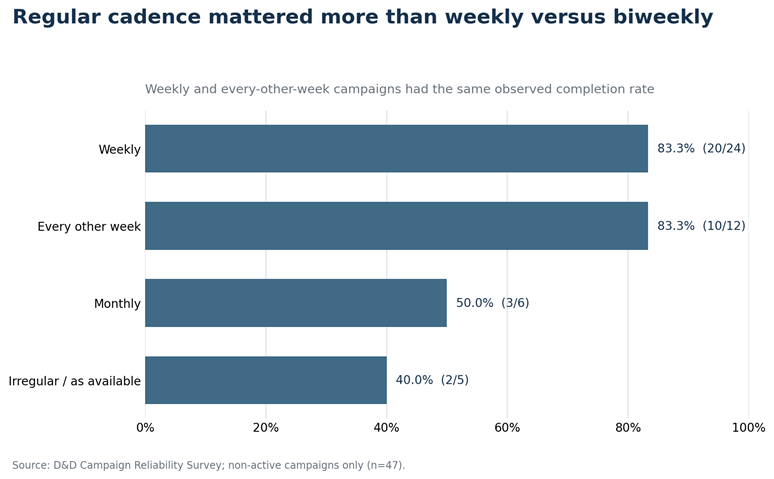
The defensible conclusion is not “play every week.” It is “choose a repeatable weekly or biweekly rhythm.” Within this sample, regularity separated the stronger categories from monthly and as-available scheduling; weekly versus biweekly did not.
The ability to play one person short was the clearest divide
Campaigns that usually or sometimes continued when one regular player was absent completed in 28 of 33 cases, an observed rate of 84.8%. Campaigns that cancelled whenever one player was absent completed in seven of 13 cases, or 53.8%. That is a 31-point difference.
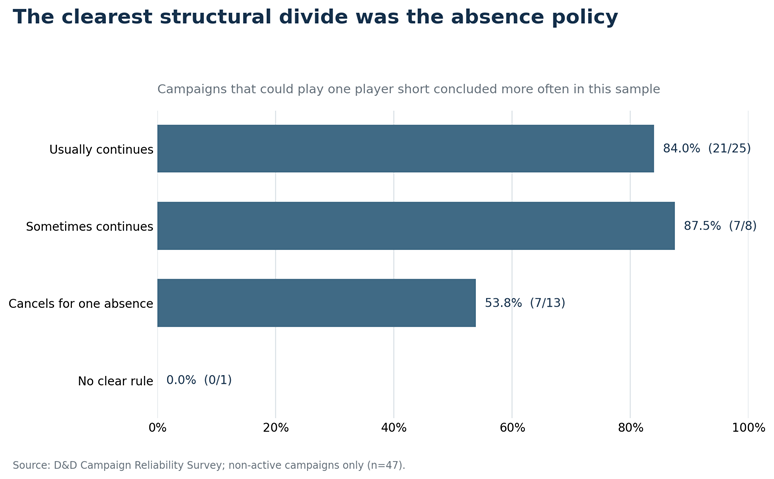
This is the most directly actionable finding in the survey. A campaign can establish its quorum before play begins: the session proceeds when the GM and all but one regular player can attend. The group can reserve exceptions for major character scenes or campaign finales without making unanimous attendance the default requirement.
Again, the survey does not prove that the policy itself caused completion. It does prove that campaigns capable of continuing through one absence concluded substantially more often in this set of responses.
Short campaigns were not automatically safer
A compact campaign sounds easier to finish because it requires fewer successful sessions. That expectation did not appear in these responses. Only one of four campaigns planned for five to eight sessions concluded. Six of seven campaigns planned for more than 20 sessions concluded, as did 14 of 16 campaigns built around a story arc without an exact session count.
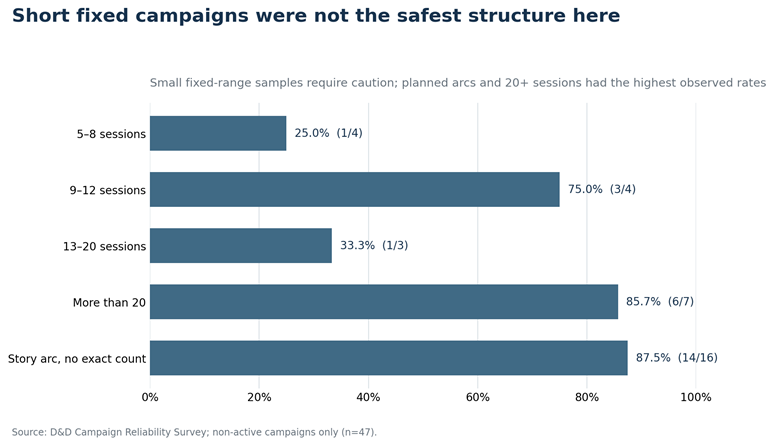
The fixed-duration categories are small, particularly at the shorter ranges, so they cannot establish that longer campaigns are inherently more reliable. They do establish something narrower: this survey provides no evidence that merely shortening a campaign creates resilience.
A resilient structure may need enough room to adapt. Five campaigns reported that their intended ending changed during play, and all five still reached a completed status. That does not prove that changing the ending improves reliability, but it shows that completion did not require rigid loyalty to the original destination.
Preparation had a middle-range high point, not a simple rule
Campaigns with one to two hours of GM preparation completed in 10 of 11 cases. By contrast, campaigns reporting three to four hours completed in three of eight cases. The extremes do not form a usable pattern: campaigns with less than 30 minutes of preparation completed in three of three cases, while campaigns with five or more hours completed in two of two.
The responsible conclusion is limited. One to two hours was the strongest well-represented preparation category. The survey does not show that a specific amount of preparation causes completion, and the very small extreme categories prevent a clean claim that either low or high preparation is safer.
Relationships mattered, but not in the obvious way
Groups in which some players knew one another and some did not completed in 17 of 19 cases, or 89.5%. Groups composed mostly of strangers completed in seven of nine cases. Mostly casual friends or acquaintances completed in eight of 13 cases, while mostly close friends or family completed in three of six.
This does not demonstrate that close friendships make campaigns less reliable. The survey measured broad familiarity categories, not the quality of those relationships, how conflict was handled, whether players shared expectations, or whether friendship obligations made cancellation easier. The result is useful mainly as a warning: “we are all good friends” is not, by itself, a reliability structure.
What the survey did not measure
Several plausible influences sit outside the data and therefore outside the model:
- Player age and life stage, including children, caregiving duties, school, retirement, and work stability.
- The quality and durability of the relationships among participants.
- The GM’s and players’ general tabletop experience.
- How strongly participants prioritized the campaign relative to competing obligations.
- The group’s conflict-resolution habits, shared expectations, and willingness to replace departing players.
These omissions should be acknowledged, but they should not be used to explain away inconvenient results. Because the survey did not measure them, it cannot tell us how much influence they had or how they interacted with player count, cadence, or absence policy.
A practical resilient-campaign template
If the goal is to design around the strongest observed structural characteristics, the campaign brief would read as follows:
Roster: Recruit five regular players, excluding the GM.
Cadence: Choose a fixed weekly or every-other-week slot.
Quorum: Play when the GM and at least four of the five players are available.
Scope: Plan a substantial story arc; do not assume a five-to-eight-session campaign is automatically safer.
Flexibility: Permit the route to the ending—and, when necessary, the ending itself—to change during play.
GM workload: Use one to two hours of preparation as the survey’s strongest represented reference point, while adapting to the GM and campaign.
Social structure: Do not treat friendship alone as a continuity plan. Establish attendance and cancellation expectations explicitly.
The real lesson is structural
A resilient campaign is not one in which nothing goes wrong. Players will miss sessions. Work schedules will change. A GM will occasionally arrive underprepared. The relevant question is whether the campaign has enough margin to keep moving when those things happen.
In this survey, the most persuasive structure was neither a tiny group nor a relentlessly weekly commitment. It was a five-player roster, a regular weekly or biweekly rhythm, and permission to play one person short. That model does not guarantee an ending. It does something more useful: it reduces the number of ordinary disruptions capable of stopping the campaign altogether.
Methodology note
Source: D&D Campaign Reliability Survey (Responses). Analysis excludes 63 campaigns listed as active and still playing. “Completed” means the respondent selected “Completed with an intended ending.” The comparison group includes 35 completed campaigns, eight abandoned campaigns, three campaigns paused but expected to resume, and one paused indefinitely. Rates are descriptive and have not been adjusted for sampling bias, duplicate campaign responses, or unmeasured participant characteristics.
Discover more from The Stygian Labyrinth
Subscribe to get the latest posts sent to your email.