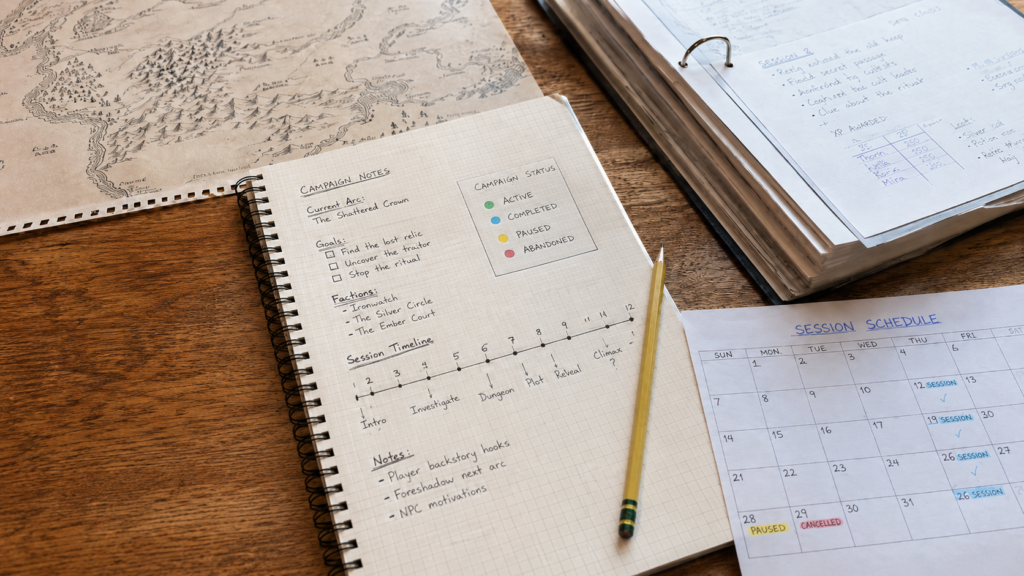
D&D has no shortage of advice.
There are endless articles, videos, forum threads, and social posts about how to prep better, run better encounters, write better villains, build better characters, manage better tables, and tell better stories.
But there is one basic question the hobby rarely measures clearly:
How often do D&D campaigns actually keep going?
Not how good they sound in session zero.
Not how ambitious the premise is.
Not how beautiful the map is, how detailed the lore is, or how excited everyone was when the group chat first formed.
I mean the practical question:
Does the campaign continue, complete, pause, or quietly disappear?
That is what the D&D Campaign Reliability Survey is trying to measure.
What Is Campaign Reliability?
Campaign reliability is the gap between the game people intend to play and the game they actually manage to sustain.
For an open-ended campaign, reliability might mean the table continues playing consistently over months or years.
For a limited-run campaign, reliability might mean the group reaches the intended ending, even if the campaign only lasted six sessions.
A campaign does not need to last forever to be successful. A short campaign that reaches its conclusion is not a failure. A long-running campaign that eventually ends with intention is not a failure either.
The problem is that many campaigns do not end that way.
They stall.
They pause “for a few weeks” and never return.
They collapse under scheduling pressure.
The DM burns out.
Players drift away.
The story loses direction.
The group keeps meaning to play, but the next session never quite happens.
Most people who play D&D have experienced some version of this. Yet most of what we have is anecdotal. We know what happens at our own tables. We hear stories from friends. We see posts online. But we do not have much in the way of practical benchmarks.
That is the purpose of this survey.
What the Survey Is Measuring
The survey asks about one D&D campaign: current, completed, paused, or abandoned.
It looks at things like:
- whether the campaign is active, completed, paused, or abandoned
- whether it was open-ended or limited-run
- how many sessions it played
- how often the group intended to meet
- how often the group actually met
- how often sessions were cancelled
- whether the game continued when one player was absent
- whether the campaign was online, in-person, hybrid, or at a game store
- how the group originally formed
- whether the players knew each other before the campaign
- GM prep time and burnout
- player turnover
- satisfaction, momentum, and confidence about the campaign continuing
The goal is not to grade anyone’s table.
The goal is to understand what patterns show up across many tables.
Do online campaigns last longer or shorter than in-person campaigns?
Do groups of existing friends have more staying power than groups formed through online LFG channels?
Do tables that continue when one player is absent have better campaign longevity?
Are limited-run campaigns more likely to reach a satisfying conclusion than open-ended campaigns?
Do DMs and players perceive campaign momentum differently?
Those are the kinds of questions this project is meant to explore.
Successful Campaigns Are Useful. Failed Campaigns Are Essential.
If you are currently in a thriving campaign, your response is useful.
If you completed a campaign and reached the ending, your response is useful.
But if your campaign stalled, paused indefinitely, collapsed, faded out, or ended without resolution, your response is especially valuable.
This survey is not only for success stories.
In fact, the project will be much weaker if it only collects responses from stable, happy, long-running tables.
Campaigns that did not survive can tell us a lot:
- where campaigns tend to break
- which warning signs show up early
- whether scheduling is really the main culprit
- how much GM burnout matters
- whether player disengagement is visible before a campaign stops
- whether campaign scope gets away from the group
- whether people can tell when a campaign is in trouble
So if you have a campaign that died after three sessions, that matters.
If you had a campaign that was supposed to be a six-session arc and somehow became a two-year saga, that matters.
If your group kept playing for years but only because you changed how attendance worked, that matters.
If your campaign ended, but the same group immediately started something new, that matters too.
DMs and Players Are Both Encouraged to Respond
Dungeon Masters and Game Masters often have the clearest view of campaign structure: intended length, prep time, scheduling expectations, and whether the campaign reached the planned arc.
Players often have a different view. They may have a clearer sense of whether the campaign feels like it has momentum, whether the table still seems invested, or whether the game is quietly losing energy.
Both perspectives matter.
A campaign can look stable from behind the screen and feel shaky from the player side.
A campaign can feel casual to the DM and deeply important to the players.
A campaign can be struggling for reasons that no one has fully named yet.
The more responses the survey receives from both DMs and players, the better the final picture will be.
Privacy and Data Use
The survey is anonymous.
It does not ask for your name, your players’ names, or your campaign’s real name.
There is an optional question that lets you create a short campaign code if you think someone else from your table may also respond. That code should not include real names. It is only there to help identify possible duplicate reports from the same campaign.
The results will be analyzed in aggregate and used to create a public summary of findings. Individual comments may be used only if they are non-identifying and helpful for explaining a broader pattern.
This is a community survey, not a scientific census of all D&D campaigns. The results should be read as directional benchmarks, not absolute claims about the entire hobby.
But directional benchmarks would still be useful.
Right now, the hobby has a lot of advice and a lot of assumptions. A clearer look at how campaigns actually continue, complete, and collapse could help DMs, players, creators, and communities think more honestly about what keeps games alive.
Take the Survey
If you have played in or run a D&D campaign, your response can help.
Current campaigns count.
Completed campaigns count.
Paused campaigns count.
Abandoned campaigns count.
Short campaigns count.
Long campaigns count.
Online, in-person, hybrid, home games, game-store campaigns, and public tables all count.
The survey takes about 5–8 minutes.
Take the D&D Campaign Reliability Survey:
Read more about the survey, review the early findings, or explore the current dataset and results.
If you run a Discord server, forum, newsletter, local game store community, or D&D group, you are welcome to share the survey as long as it fits your community rules.
The more varied the responses are, the more useful the final report will be.
Let’s find out what actually keeps campaigns going.
Discover more from The Stygian Labyrinth
Subscribe to get the latest posts sent to your email.