With just over 100 responses to our Campaign Reliability Survey, we can start to draw some loose conclusions. Before we present numbers and conclusions, we have to responsibly say that these responses come from a non-random, self-selected group spread over Discord, Bluesky, Reddit, Facebook, and TikTok. We immediately saw a bias towards DMs talking about the longevity of their campaigns, which was not matched by player experience. This is to simply say, what is presented here is not scientific and additional more thorough surveys may overturn these results. It is our intention to follow up our findings with additional research including interviews.
The Secrets to Completing an RPG Campaign
Our original hypothesis was campaigns failed more often than not. While we still believe this, our respondents were more excited to present campaigns that were successful. Valuable information was still gathered from this sample and we are cautiously drawing some basic conclusions.
Common sense tells us that cancelling sessions is an indicator of a campaign in crisis. That would be wrong.
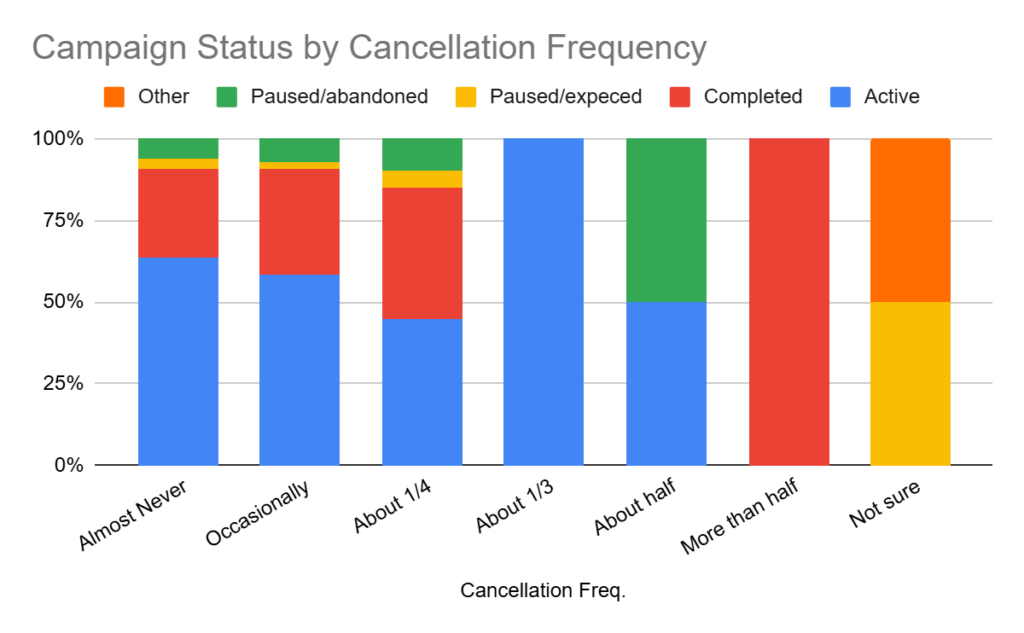
Nearly 90% of campaigns that had occasional cancelations are still active or came to a planned conclusion. The cancelation isn’t a cause for campaigns being abandoned. Even campaigns that cancel every third session are still active.
This indicates that what keeps campaigns going is momentum.
For those games that never cancel or cancel occasionally, do all the players show up for every session? 81% of the campaigns that are still active or reached an intended conclusion kept playing when 1 player was absent. Campaigns that can continue with one player missing survive. This means that campaigns that are only a few players suffer the most when players are absent.

Tables with 4 or less players cancel sessions more often. This makes sense as it is more likely that PC is part of a critical part of the story. Tables with 7+ players didn’t replay in enough quantity to be significant to these results but anecdotal evidence shows those tables continued to play with few cancelations but routinely had players absent. The more players, the more potential schedule conflicts.
This leads us to the first secret of bringing a campaign to a successful conclusion.
Have a Policy for Canceling Games
- Games will get canceled, but that should be the exception not the rule.
- Have a clear and consistent schedule for game play so players can lock it in on a calendar.
- Have an absentee policy for players. For example, “We play with three.” If three of the players can attend, the session continues. The exceptions would be for critical plot points revolving around that player’s character (though this is an opportunity to do backstory play or do character development play) or if the group is in the middle of a significant combat.
- Plan campaigns around 5-6 players to have enough players to keep the game going if one is missing for a session.
Burnout is a Risk Multiplier
Most campaigns reporting GM burnout are still active or completed, but burnout appears in a meaningful share of failed or at-risk campaigns. Burnout may be less of an automatic campaign killer and more of a risk multiplier when paired with cancellations, prep collapse, or loss of momentum.
18% of the campaigns reporting GM burnout fail to reach a conclusion. While the burnout itself cannot be attributed to this failure, it is a contributing factor. One of the core issues we have here is not knowing exactly what everyone means by GM burnout, but as a general guideline it shows up in a few ways. The GM canceling games because prep isn’t done. The GM not putting the same level of energy into the sessions as she normally did. Or the campaign suddenly losing a sense of cohesion. One of the responses included the following observation.
“It ended at an intended deadly fight, possibly because the DM was done with it or wanted something to change, but we were so unsatisfied by the TPK that we decided to start something new.”
Having a plan for when the GM is burnt out can save campaigns as well. For example, this respondent discusses what happens when the burnout caused a lengthy pause in the campaign:
“There was a bit of time where I was experiencing severe GM burnout, and talked to my players and we all agreed to play something else while I took a break and got myself back together. We stuck together during that break, and now that it’s over, I’m feeling good about the game again.”
Our conclusion is it is better to head off burnout before it happens. That might mean different things for everyone but having scheduled downtimes might be one solution. Play for 10 weeks, take a brief hiatus. Or once every three months, the table plays something the GM doesn’t have to do any prep for.
Additionally, as a side project we started identifying the “work” the GM has to do for the campaign and maybe it is possible for a few players to step in and take on the burden.
The Invisible Labor of the GM
- Scheduler
- Reminder-sender
- Recap writer
- Rules adjudicator
- Prep lead
- Host or tech manager
- Attendance tracker
- Conflict mediator
- Safety monitor
- VTT maintainer
- Lore keeper
- Pacing manager
- Session starter
- Session closer
- Morale monitor
Some of these jobs are necessarily the responsibility of the GM. But some… some are almost better if a player takes them on. For example if your campaign uses a virtual table top, a player should become the tech support for that system. The GM need to be the safety monitor but a trusted player should be the backup safety monitor. Scheduler and chief catsherder of trying to lock down everyone to play is another acceptable outsourced role.
Burnout isn’t just the creativity, it is related to everything the GM has to do to make the campaign happen. Even just having one or two of the administrative duties picked up by a player or two helps distribute that load.
The Real Secret: Build a Campaign That Can Recover
The early results of the Campaign Reliability Survey do not point to one single reason campaigns succeed or fail. Campaigns do not appear to survive because nobody misses sessions, nobody burns out, nobody leaves, and nothing ever goes wrong. That is not how real tables work.
Instead, the campaigns that survive seem to have something more useful: recovery habits.
They know what happens when one player is absent. They have a regular schedule. They do not treat every cancellation like a crisis, but they also do not allow cancellations to become common. They recognize that the GM is doing more than telling a story, and they find ways to reduce that burden before burnout becomes collapse.
That may be the most important lesson from this first batch of responses.
A reliable campaign is not a perfect campaign. It is a campaign with enough structure, trust, and shared responsibility to keep moving after normal life interrupts it.
For DMs, that means the goal is not to become an endless source of creative energy. It means building a table that can keep functioning when your energy dips.
For players, that means showing up matters, but so does helping the campaign exist. Someone can handle scheduling. Someone can write the recap. Someone can learn the VTT. Someone can check in when momentum starts slipping. These are not glamorous jobs, but they may be the difference between a campaign that reaches its ending and one that quietly disappears.
The first secret to completing a campaign may be this:
Do not just plan the story; plan how the table will survive the things that interrupt the story.
This survey is still early, and these findings should be treated as directional rather than definitive. The current responses are self-selected, DM-heavy, and not a scientific sample of the entire hobby. But even with those limits, the pattern is useful. Campaign reliability seems less about avoiding friction and more about designing for resilience.
The next phase of this project will continue gathering responses, looking for stronger patterns, and following up with interviews to better understand what reliable tables actually do differently.
If you have not taken the survey yet, especially if you have been part of a campaign that paused, collapsed, burned out, or ended messily, your response is valuable. Success stories are helpful, but failed campaigns may teach us even more.
Add your experience to the survey.
The hobby has plenty of advice about starting campaigns. We need better knowledge about how campaigns keep going.
Discover more from The Stygian Labyrinth
Subscribe to get the latest posts sent to your email.