GUILD OF LOST LORE · ENCOUNTER DOSSIER SL-E-001
The forest is a weapon.
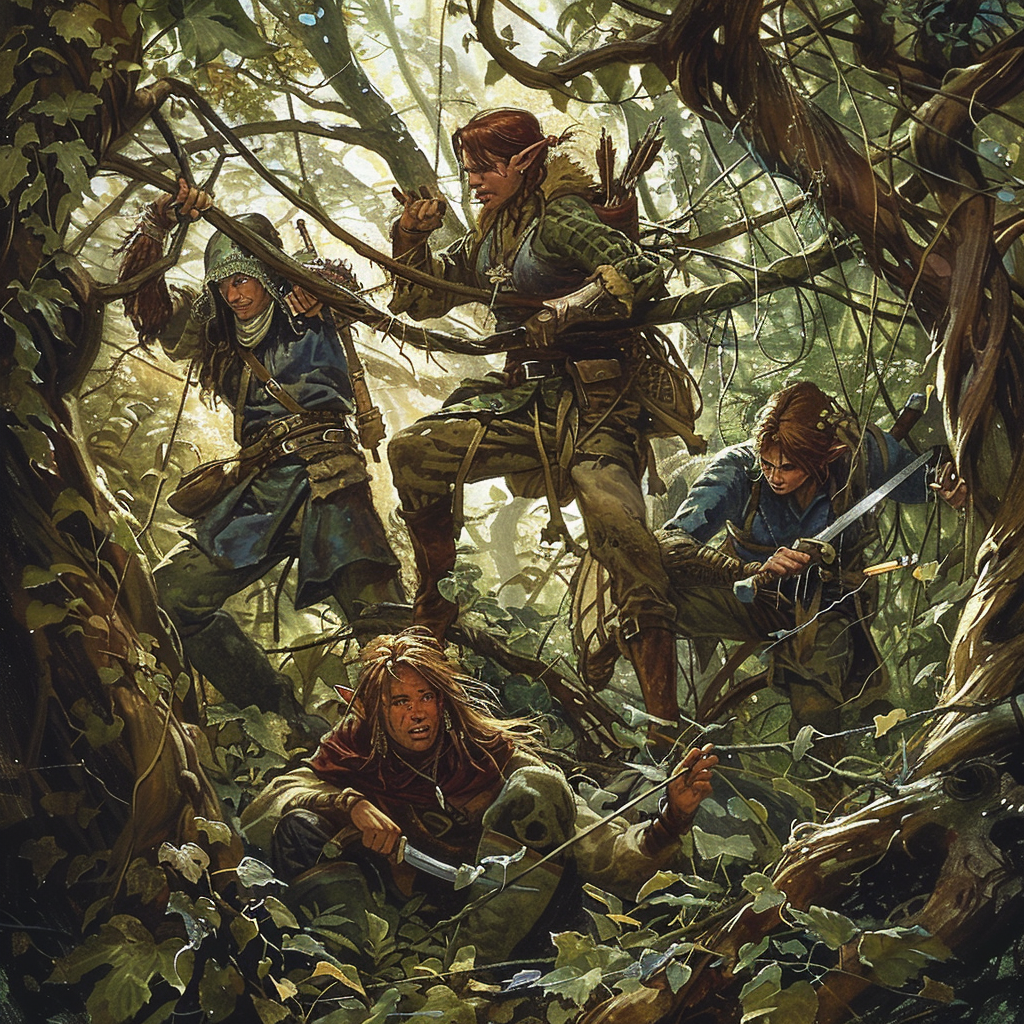
A goblin tribe has turned a narrow trail through Tanglewood into a living trap. Vines tighten. False paths fold back on themselves. Stones fall from the canopy. Every delay gives unseen archers another clean shot.
The Treacherous Trails of Tanglewood is a ready-to-run forest encounter for four 3rd-level characters. It works as a dangerous interruption during travel, the guarded approach to a goblin settlement, or the first evidence that someone has organized the local goblins into something more disciplined.
AT A GLANCE
Party
Four characters
3rd level
Duration
60–90 minutes
One encounter
Opposition
Four goblins
One Trapmaster
Pressure
Traps, elevation
and harassment
THE SITUATION
The goblins do not defend a line. They control movement.
The party enters a section of ancient forest where the trail divides among thick roots and thorny undergrowth. A goblin band has spent weeks converting the area into a hunting ground. They do not intend to meet intruders in a fair fight. Their traps isolate one target, force the others to stop, and create openings for arrows from concealed platforms.
The goblins retreat whenever the characters close with them. Their leader—the Goblin Trapmaster—watches from deeper in the maze, changing routes and setting quick snares until the party either breaks through or forces a decisive confrontation.
The trail narrows between two black-barked trees. Ahead, a strip of red cloth hangs from a thorn branch. Somewhere above you, wood creaks under a shifting weight. Then comes a laugh—high, brief, and answered from three different directions.
Encounter objective: The characters must cross the trapped ground, drive off the goblins, or capture the Trapmaster. Killing every enemy is possible, but it is not required.
RUNNING THE ENCOUNTER
Start initiative when the forest answers back
1. Warning
Show one sign before the first danger: a cut vine, disturbed leaves, a red cloth marker, or a goblin footprint where no traveler would naturally step. A cautious party can discover that the trail is trapped before initiative begins.
2. Trigger
Roll initiative when a trap activates, a character begins dismantling one, or the party attacks a hidden goblin. Place two goblins in elevated cover and two on opposite sides of the trail.
3. Escalation
The Trapmaster joins at the start of round three, or immediately after the party bypasses two traps without triggering them. He enters from the direction the characters believe is safest.
Forest terrain: Squares beyond the marked path are difficult terrain. Thick trunks provide half cover. Goblin platforms stand 10 feet above the ground and can be reached by rope ladders, climbing the tree with a DC 12 Strength (Athletics) check, or cutting the support rope.
Spotting a trap: A character actively searching the area can make a Wisdom (Perception) check against the trap’s detection DC. A character whose passive Perception meets that DC notices the trap before entering its space. Once found, a trap can usually be disabled with a DC 13 Dexterity check using thieves’ tools or improvised around with a suitable plan.
THE TRAP GAUNTLET
Four traps, four different decisions
Use all four traps for the complete encounter. For a faster scene, choose any three. Never place two damaging traps where one forced movement can trigger both; the danger should come from the goblins exploiting a trap, not from an unavoidable chain of damage.
Vine Snare
Detection DC 13 · Trigger DC 13 Dexterity
A loop of vine tightens around the creature’s ankle and hoists it 10 feet into the air. On a failed save, the creature is restrained. It can escape with a DC 13 Strength (Athletics) or Dexterity (Acrobatics) check. The vine has AC 12 and 5 hit points. Cutting it drops the creature, which takes 1d6 bludgeoning damage unless someone breaks the fall.
Goblin response: One archer targets whoever moves to cut the victim down.
Covered Pit
Detection DC 14 · Trigger DC 13 Dexterity
A mat of woven branches collapses into a 10-foot pit. On a failed save, the creature falls, taking 1d6 bludgeoning damage and 1d6 piercing damage from sharpened stakes. A creature can climb out with 10 feet of movement and a DC 10 Strength (Athletics) check. Removing the stakes before climbing takes an action.
Goblin response: A goblin rolls a thorn bundle over the opening, giving the trapped creature half cover but making the climb DC 13.
Rockfall Tripwire
Detection DC 13 · Trigger DC 13 Dexterity
A tension line releases stones from a net in the canopy. A creature that fails the save takes 2d6 bludgeoning damage; on a success, it takes half damage. The stones fill a 10-foot square, which becomes difficult terrain and half cover until cleared. Clearing a 5-foot passage takes an action.
Goblin response: The goblins reposition while the party’s line of sight is broken.
Poison Dart Line
Detection DC 14 · +5 ranged attack
A concealed tube fires at the creature that crosses the line. On a hit, the dart deals 1d4 piercing damage, and the target must succeed on a DC 12 Constitution saving throw or be poisoned until the end of its next turn. A detected dart tube can be turned toward another lane with a DC 13 Dexterity check using thieves’ tools.
Goblin response: A goblin tries to drive a poisoned target toward the Trapmaster.
MINI-BOSS
Goblin Trapmaster

Small humanoid (goblinoid), neutral evil
Armor Class 15 (leather armor)
Hit Points 27 (6d6 + 6)
Speed 30 ft.
STR 10 (+0) · DEX 16 (+3) · CON 12 (+1) · INT 14 (+2) · WIS 11 (+0) · CHA 8 (−1)
Skills Investigation +4, Perception +2, Stealth +7
Senses darkvision 60 ft., passive Perception 12
Languages Common, Goblin
Challenge 2 (450 XP) · Proficiency Bonus +2
Cunning Action
On each of its turns, the Trapmaster can take the Dash, Disengage, or Hide action as a bonus action.
Actions
Multiattack. The Trapmaster makes two dagger attacks.
Dagger. Melee or Ranged Weapon Attack: +5 to hit, reach 5 ft. or range 20/60 ft., one target. Hit: 5 (1d4 + 3) piercing damage.
Quick Snare (Recharge 5–6). The Trapmaster throws a weighted loop at one creature it can see within 30 feet. The target must succeed on a DC 13 Dexterity saving throw or become restrained. A restrained creature can use its action to make a DC 13 Strength (Athletics) or Dexterity (Acrobatics) check, ending the effect on a success. The snare also ends if it takes 5 slashing damage.
Redirect Trap (1/Day). The Trapmaster triggers one detected but undischarged trap within 60 feet. If no creature occupies its trigger area, he can shift the trap’s affected area up to 5 feet before it activates.
ENEMY TACTICS
The goblins fight to preserve the maze
Opening
The archers attack characters stopped by traps or clustered around a rescue. Ground goblins Hide, then appear on the opposite side of the trail to threaten a new angle.
Middle
The Trapmaster restrains mobile characters and uses Disengage to keep a trap between himself and the party. Goblins never end a turn adjacent to an unrestrained melee attacker if they can retreat.
Retreat
When two goblins fall or the Trapmaster drops below 10 hit points, surviving goblins flee toward their settlement. The Trapmaster surrenders if escape is impossible; he values his cleverness more than martyrdom.
Keep the pressure fair: Do not hide every threat behind a single failed Perception check. Show the players how the goblins use the terrain. Once the party understands the pattern, let planning, spells, tools, and unconventional movement dismantle it.
ADJUSTING THE DIFFICULTY
Change the pressure, not just the hit points
For a less experienced party
Use three goblins, delay the Trapmaster until round four, and reduce damaging traps to one damage die. Place visible goblin markers near two traps so the party understands that the forest has been deliberately engineered.
For a stronger party
Add two goblins and begin a six-round clock when initiative starts. At the end of round six, reinforcements arrive or the party’s quarry escapes deeper into the forest. Do not increase every DC; urgency creates difficulty without making player skills irrelevant.
AFTERMATH & WORLD BUILDING
A trap line implies something worth protecting
Searching the Trapmaster reveals 28 gp in mixed coins, a roll of fine copper wire worth 10 gp, three doses of basic poison, and a charcoal map showing the safe route through this section of Tanglewood.
The map also contains one detail that points beyond the encounter. Choose the clue that best serves the campaign: a marked goblin settlement, the symbol of a patron supplying metal and poison, a warning around an older ruin, or a second trail labeled only with a crown made of thorns.
A captured Trapmaster bargains readily. He can guide the party past one later forest hazard, identify the tribe’s enemies, or explain why the goblins began fortifying the trail. If released, he remembers both mercy and humiliation—and improves every trap before the characters return.
SET THE TRAIL
Build the map as a sequence of choices
Draw one winding trail with two false branches, four trap zones, three elevated goblin positions, and a clearing for the final confrontation. Leave at least one route that is longer but free of damaging traps. The map should reward observation and adaptation, not demand that the party guess the one correct path.
SL-E-001 is designed to be dropped into any ancient or overgrown forest. Change the goblin tribe, the protected location, and the final clue to anchor Tanglewood in your own world.
Adventure & Worldbuilding from the Guild of Lost Lore · The Stygian Labyrinth
Discover more from The Stygian Labyrinth
Subscribe to get the latest posts sent to your email.