GUILD OF LOST LORE · ADVENTURE DESIGN & WORLDBUILDING
A practical framework for turning a simple premise into a situation with pressure, meaningful choices, and lasting consequences
Originally published as two articles in June 2013. This combined edition preserves the worked example while reframing the structure around situations, active pressure, multiple approaches, meaningful failure, and player-driven continuity.
All gamemasters eventually write an adventure that looks better in their notes than it plays at the table. The map is detailed. The villain has a history. The final encounter is carefully balanced. Then the players become interested in the wrong person, avoid the expected fight, or ask a question the adventure never considered.
That is not a failure of the players. It is a weakness in the adventure’s structure.
When I began writing adventures as a teenager, most of them followed the same dependable formula: the characters met someone at an inn, heard about monsters in a nearby tunnel, killed the monsters, recovered the object, and returned for a reward. I still call this Fight and Fetch. There is nothing inherently wrong with it. Clear objectives are useful, monsters are fun, and retrieving a dangerous object gives everyone a reason to enter the dungeon.
The problem begins when the formula is also the entire structure. If the characters refuse the patron, negotiate with the monsters, lose the object, or give it to someone else, the adventure has nowhere to go.
A memorable adventure does not require a more complicated plot. It requires a situation that can survive contact with the players. The gamemaster needs to know what is happening, who wants something, what pressure is changing the situation, and what consequences follow from the characters’ decisions. The players decide the route through it.
This article builds that kind of adventure from an intentionally ordinary premise. The goal is not to produce a masterpiece. It is to show how a simple job involving an inn, some goblins, a ruined temple, and an ancient artifact can become a playable situation with choices, tension, and continuity.
Begin with a Problem Already in Motion
A logline is a short summary of the initial situation. It is not a script and it does not need to describe the ending. Its job is to identify the problem, the people involved, and the reason the situation cannot remain unchanged.
For this example, I will begin with something my fourteen-year-old self would have understood immediately.
While the characters rest at the Hidden Jest, the wizard Yillindra asks them to investigate goblin raids from a newly discovered ruin and recover the Orb of Chaos before someone else reaches it.
That is still Fight and Fetch, but it contains several useful uncertainties. Yillindra may not be telling the whole truth. The goblins have their own reason for occupying the ruins. Someone else may want the Orb. Even success requires the characters to decide who should possess it.
The situation is also moving before the characters arrive. The goblins have attacked caravans. Yillindra has asked scholars, collectors, and magical contacts about the Orb. Those inquiries have attracted attention. Somewhere beyond the village, people who claim to be the Orb’s original owners now know that it may have been found.
The characters are not being asked to start the story. They are entering a story that has already started without them.
Know What Happens If Nobody Intervenes
Before building the village or drawing the ruins, decide what happens if the characters do nothing. This gives the adventure direction without dictating their actions.
The goblins continue raiding the road because Agaret, their leader, needs supplies and trophies to secure his position as the next warchief. Yillindra continues making inquiries. Those questions allow the original owners to identify the ruins. Their agents arrive, follow the same trail, and eventually enter the temple. If nobody interferes, someone other than Yillindra will recover the Orb, and the village will become the meeting point for several groups that believe it belongs to them.
That is enough movement to keep the adventure alive. The gamemaster does not need to know every action the characters might take. The gamemaster needs people and pressures capable of responding when they take an unexpected one.
Turn the Premise into Questions
The logline gives us an inn, a wizard, goblins, ruins, raids, and an artifact. Each noun creates questions worth answering.
Where is the inn, and why do travelers stop there? Who carries news along the road? Who has authority over the area? What do the goblins need from the caravans? Why were the ruins unknown? What did the temple originally do? Why does Yillindra want the Orb? What has she told other people while researching it? Who owned it before the cult took it? What happens when those owners learn where it is?
Not every question deserves an answer before play. Answer the questions that help the gamemaster portray the immediate situation, reveal useful information, or decide how the world responds. Leave distant history and unused cosmology alone until the campaign needs them.
This is an important distinction. Worldbuilding is not preparation for every possible player action. That is impossible. Useful worldbuilding creates people, places, facts, and pressures that the gamemaster can combine when the players do something unanticipated.
Build the Immediate Place First
The Hidden Jest stands in a crossroads village between three cities. Farmers supply the inn. Smiths, chandlers, hostlers, and herbalists serve travelers. Couriers exchange messages there, merchants form caravans there, and rumors arrive from several directions.
That makes the village useful. It is not a painted backdrop placed in front of the dungeon. It is where the characters can gather information, find equipment, hear competing versions of events, and observe the cost of the raids.
Baris, the innkeeper, is jovial, observant, and known for cooking meals wealthy travelers remember. He has served military officers, merchants, and minor nobles, which means he recognizes insignia and remembers unusual guests. Norm, a permanent fixture at the bar, knows local gossip. Cliff, a courier, knows what is happening beyond the village. These people do not need full biographies. They need a reason to be present and something useful they can notice, know, need, or misunderstand.
The village falls under Sheriff Rhynne’s authority, although she visits only twice each month. Her lieutenant, Castido, handles most local problems. Rhynne was appointed by the prince of the nearest city, while the other two cities resent his claim over the crossroads. That political tension matters because Yillindra’s research has brought strangers into disputed territory. We do not need three pages about the cities. We need to know why their representatives might interfere here.
Build outward only as play requires it. The immediate place comes first. Then establish the roads, authorities, resources, and threats connected to it. The larger world can wait until something in the adventure pulls it closer.
Build the Cast Around Wants
Names make NPCs easier to reference, but desire makes them easier to run. For each important person or faction, decide what they want, what they can use to pursue it, and what they will not willingly sacrifice.
Yillindra – Wants the Orb brought to her so she can study it and confirm what it does. She has money, magical knowledge, scrying, and a network of correspondents. She will conceal how widely she asked about it, but she does not want the village destroyed or the Orb activated recklessly.
Sheriff Rhynne – Wants to preserve the prince’s authority and prove that Yillindra is creating problems beyond her control. She can use deputies, warrants, roadblocks, and official suspicion. She will seize the Orb if she believes it is dangerous, but she will not knowingly hand it to a foreign claimant.
Agaret – Wants treasure and a victory impressive enough to make him the next goblin warchief. He has scouts, traps, raiders, and knowledge of the outer ruins. He will bargain if it preserves his status and followers; he will not accept public humiliation.
Bennis – Wants to remain loyal to Yillindra while keeping his wife and son outside her dangerous affairs. He knows her routines, visitors, and recent shipments. He will not deliberately betray her, but concern for his family can make him reveal more than he intended.
The original owners – Want the Orb returned and believe it was stolen from their order generations ago. Their agents have records, money, magical expertise, and a legitimate historical claim. Whether they are trustworthy is a separate question. They will negotiate for the Orb, but they will not quietly surrender their claim to Yillindra, the sheriff, or the characters.
This is the active cast. Other villagers and goblins can be created when needed from simple roles and names. A manageable cast is not measured by the number of names in the notes. It is measured by whether the gamemaster can see who will act when the situation changes.
Give the Characters Reasons to Care
The players have come to the table to participate, but their characters still need credible reasons to enter danger. Money, recognition, and mystery remain useful motivators, but they are not the only ones.
Yillindra offers payment for recovering the Orb. Baris explains that the raids are making food and lamp oil more expensive. Cliff is overdue because the road has become unsafe. A character interested in magic may recognize the Orb’s name. A character tied to law or nobility may want to speak with the sheriff before accepting work from a secretive wizard. Someone with sympathy for outsiders may wonder why the goblins are raiding instead of trading.
The gamemaster does not need every hook to work. Offer several handles and let the players decide which one they pull. Their choice tells you what kind of adventure they believe they are entering, and that information should influence what receives attention at the table.
Player buy-in is not permission to ignore character motivation. It is an agreement that the group will find a reason to engage while the gamemaster gives them something worth engaging with.
Make the Opposition Active
The goblins discovered the ruins months ago while searching for treasure. They established a camp in the outer chambers, found several valuable objects, and sealed the stairs leading deeper after two explorers failed to return. Agaret began raiding caravans because supplies from the goblin kingdom are unreliable and because captured goods make him look successful.
This means the goblins are more than a collection of stat blocks. If the characters attack, Agaret uses the trails, traps, and narrow entrances to control movement. If the characters negotiate, he may trade passage into the lower temple for supplies, recognition, or help recovering a lost goblin. If the characters sneak past him, he may follow them and attempt to take whatever they recover. If they withdraw, he strengthens the approaches and accelerates the raids.
One goblin spearthrower, Mev, is an aspiring artist. He sketches animals, travelers, and parts of the ruin on scraps of hide. His drawings are not a mandatory clue, but attentive characters might recognize a guardian or temple symbol in them. If Mev survives, his work can appear later along the road or in another goblin settlement. A small detail becomes memorable when the world permits it to continue, not because the gamemaster forces it into importance.
Active opposition changes tactics, protects what it values, retreats when appropriate, and pursues goals even when the characters are somewhere else. That behavior creates more play than simply adding another monster to the room.
Build the Ruins from Their Purpose
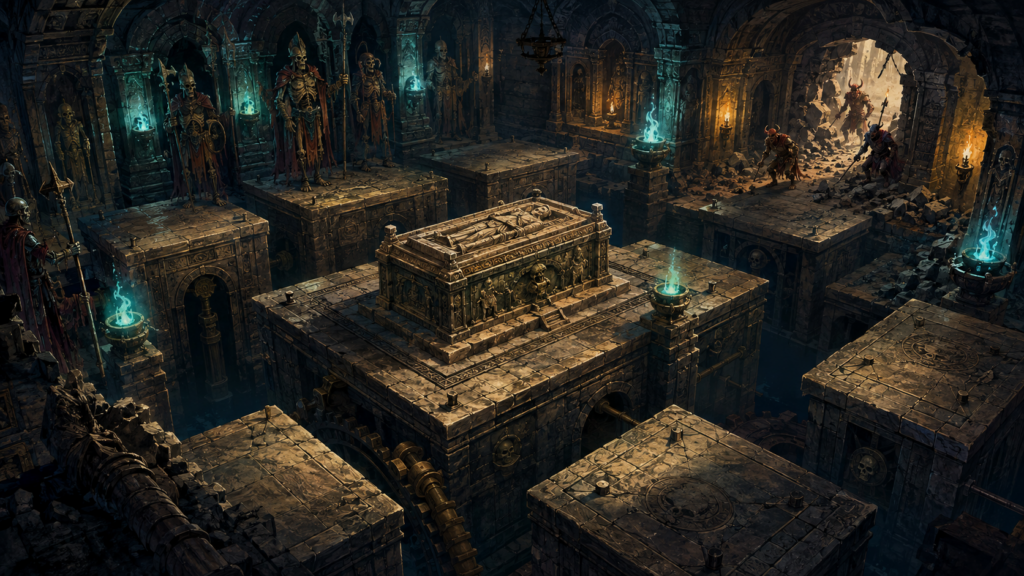
The ruins were once a temple maintained by the Disciples of Erris, a cult devoted to a goddess of chaos. Decades ago, the Disciples stole the Orb and carried it here. They placed it in a shrine below the main temple and surrounded it with magical safeguards. The cult disappeared, but its protections remain.
The temple was occupied by living people, so every corridor should not be a death trap. Acolytes needed to carry food, clean chambers, conduct ceremonies, and reach the shrine without losing a limb. Dangerous protections belong around restricted doors, sacred objects, and routes known only to initiated members.
That history gives the players ways to reason about the location. Worn floors reveal common routes. Repeated symbols identify safe doors. Records or murals explain how initiates approached the shrine. A character who studies the temple can gain an advantage that cannot be found by checking every square for traps.
The goblins have changed the outer ruins. They added snares, warning lines, concealed firing positions, and barricades. The deeper temple retains cult wards, unstable masonry, vermin, and magical guardians. These layers make the location feel occupied rather than assembled for a single party.
Design Obstacles with More Than One Answer
The final shrine may be protected by homunculi and magical wards appropriate for a low-level party, but combat should not be the only possible solution. The guardians might obey an old ritual, ignore anyone carrying a cult token, or focus on whoever touches the Orb. The characters can fight, decipher the rite, deceive the guardians, disable part of the ward, retreat with new information, or allow another faction to enter first.
Designing for the party does not mean changing the world to neutralize their choices. It means including different kinds of leverage. A rogue may understand the mechanism. A scholar may recognize the liturgy. A strong character may move a damaged stone seal. A persuasive character may turn Agaret or a rival agent into temporary help. No single ability should be mandatory, and no useful ability should be punished merely because it solves a problem efficiently.
Let the Environment Apply Pressure
One storage chamber contains shelves of ceremonial oils. Age has made some of them unstable and flammable. Collapsing shelves, broken pottery, and old timbers can transform an ordinary fight into a spreading fire.
The oil is not only a hazard. If the characters save a container, they may carry it away, sell it, study it, or turn it into a future weapon. Let them. A detail becomes part of the campaign when the players find a use for it the author did not prescribe.
Put Information Where Players Can Find and Use It
A mystery is not created by withholding every answer. It is created by giving players incomplete information that changes what they think they should do.
Yillindra admits she learned about the Orb through research and scrying, but avoids mentioning the number of people she contacted. Cliff saw a foreign courier carrying a seal that also appears in the temple. Bennis remembers unfamiliar scholars visiting Yillindra and can describe the marked bones stored in her tower. The sheriff has heard complaints about Yillindra’s inquiries from officials in another city. Agaret captured a letter from a rival expedition asking for directions to the foothills.
None of those clues tells the characters who deserves the Orb. Together they reveal that Yillindra’s job is not private, another group is approaching, and possession of the artifact will create consequences.
Important conclusions should not depend on one successful roll or one cooperative NPC. Place related evidence in several locations and allow different skills or approaches to reveal it. Failure can reduce certainty, consume time, attract attention, or worsen someone’s attitude without closing the only route forward.
Add Decisions Instead of a Predetermined Ending
Retrieving the Orb is not the end of the adventure. It is the moment when the characters finally have enough leverage to decide what the adventure was about.
They can deliver it to Yillindra, turn it over to Sheriff Rhynne, hear the original owners’ claim, leave it protected in the shrine, attempt to destroy it, hide it, or keep it. Each choice helps someone, threatens someone, and changes who trusts the characters.
The gamemaster should know what each faction believes about the Orb before play. Yillindra believes it can reveal patterns within unstable magic. The original owners claim their order contained it because it magnifies improbable events. Rhynne knows only that several powerful groups want it and therefore considers it a public danger. Agaret sees proof that he can claim wealth and authority.
The Orb’s complete history and abilities can remain undeveloped until they matter, but the evidence encountered during this adventure must be internally consistent. Delayed preparation is useful. Arbitrary answers are not.
Add a Smaller Choice That Echoes the Larger One
A merchant asks the characters to recover a stolen case of rare spice. He needs the payment from a contract with the prince to keep his caravan in business. The goblins have already mixed part of the spice into medicine for a dangerous fever spreading through their camp.
Returning everything may save the merchant and cost goblin lives. Leaving it with the goblins may ruin the merchant and further damage the road. Dividing it may help both while satisfying neither. The reward is not the moral question. Competing needs are.
This smaller problem prepares the table for the larger dispute over the Orb. Ownership is easy to describe on paper. It becomes complicated when possession, need, history, and consequence point toward different answers.
Use a Clock That Changes the Situation
Yillindra’s inquiries have already started the clock. Advance it when the characters delay, make their investigation conspicuous, suffer a major setback, or spend significant time resting. The exact pace can fit the campaign, but the stages should be visible through changes in the world.
First sign: Questions on the road – Cliff or another traveler reports strangers asking about Yillindra, the ruins, and an object called the Orb of Chaos.
Second sign: An agent arrives – A representative of the original owners reaches the Hidden Jest, questions Baris and Bennis, and offers the characters a competing account of the Orb’s history.
Third sign: A rival expedition moves – Scouts follow the characters, bargain with Agaret, or enter the ruins by another route. Rooms the party expected to find untouched now show signs of intrusion.
Final escalation: Someone else reaches the shrine – The rival group attempts to remove, secure, or activate the Orb. The characters have not automatically failed, but the objective has changed from recovery to pursuit, negotiation, theft, or damage control.
A clock should remove easy options, not remove the players’ ability to act. Its purpose is to prevent the situation from waiting politely while the characters debate forever.
Plan Failure That Changes the Adventure
The adventure should not depend on the characters winning every fight, finding every clue, or returning with the Orb. Decide what failure costs and where the story goes afterward.
If the characters retreat from the goblins, the raids grow bolder and Agaret reinforces the ruins. If they enter the temple but cannot defeat the guardians, they can return with information, seek help, bargain with another faction, or discover that the rival expedition is willing to take the risk for them. If another group takes the Orb, the adventure becomes a pursuit or political dispute rather than a dead end.
If the characters return without the Orb, Yillindra does not assume they simply failed. Her latest scrying shows that the shrine was breached and the Orb is no longer there, but she cannot locate it. Overconfident in both her divination and the competence of the people she hired, she concludes that they found it and kept it for themselves. Her reaction should be immediate and understandable. She withholds payment, questions their story, quietly uses divination to follow them, and warns selected contacts that the characters possess a dangerous artifact.
The characters can prove what happened, expose the true holder, reconcile with her, exploit her mistake, or accept that they have acquired a suspicious and powerful enemy. Even an honest failure therefore creates consequences and future choices.
If the characters actually keep the Orb, Yillindra’s incorrect-seeming accusation becomes accurate. The original owners continue searching. Rhynne may try to seize it. The object becomes a campaign problem the players deliberately chose to carry.
Failure should hurt. It may cost time, safety, trust, resources, or control of the objective. It should not make the previous session meaningless.
Let the World Respond
At the end of the adventure, record what changed.
Who possesses the Orb? Does Yillindra trust the characters? Does Rhynne consider them allies, criminals, or useful witnesses? Is Agaret alive, displaced, humiliated, or strengthened? Did Mev escape? Is the road safer? Did the merchant survive the loss of his contract? Which original owner or rival agent now knows the characters by name?
Those answers are more valuable than a predetermined sequel. They tell the gamemaster what the world does next.
The players may become interested in the marked bones in Yillindra’s tower, the true powers of the Orb, Agaret’s claim to leadership, the identity of the original owners, or the political dispute surrounding the crossroads. Follow the thread they choose. The next adventure can begin with a new problem created by what happened here.
Yillindra possesses a set of bones covered in the same writing found beneath the ruined temple, and someone has now broken into her tower to steal them.
The process begins again, but the next adventure is easier to build because the players have already helped create its people, history, loyalties, and consequences.
The Framework Beneath the Example
The names, monsters, and artifact can all be replaced. The reusable structure is what matters.
Begin with a problem – Describe something already happening that demands a decision without prescribing the response.
Establish the unattended outcome – Know what happens if the characters do nothing.
Interrogate the premise – Turn people, places, objects, and threats into questions worth answering.
Build the immediate world – Prepare the location, connections, and details the next session can actually use.
Give actors wants and limits – Decide what important NPCs and factions pursue, what resources they possess, and what they refuse to sacrifice.
Provide several handles – Give different characters credible reasons and methods for becoming involved.
Create active opposition – Let enemies and rivals react, negotiate, retreat, learn, and pursue goals of their own.
Add information and pressure – Give players clues they can use while a clock, hazard, or competing actor changes the situation.
Plan costs instead of dead ends – Decide how failure, delay, retreat, and partial success alter the adventure.
Let the world react – Record the consequences and build the next problem from whatever the players decide matters.
A memorable adventure is not one in which the gamemaster successfully predicts every player decision. It is one in which unexpected decisions reveal that the world was capable of responding all along.
Build the adventure, then follow it into the world
Use the framework beside the Adventure Library when you need something playable now, or carry its places, factions, histories, and consequences into the campaign through the Worldbuilding resources.
Discover more from The Stygian Labyrinth
Subscribe to get the latest posts sent to your email.
1 thought on “How to Write a Memorable RPG Adventure”