GUILD OF LOST LORE · REPORTS & COMMENTARY
D&D Beyond has introduced Scene Prep, a new tool designed to put the information a Dungeon Master needs directly alongside the locations and situations where it will be used.
It would be easy to review Scene Prep as another collection of features: create a scene, attach notes to a map, organize encounters, keep important information nearby, and use a Theater of the Mind organizer when a tactical map isn’t necessary.
But the interesting thing about Scene Prep isn’t really the feature list.
Scene Prep belongs to a much larger evolution in Dungeon Master preparation.
For decades, DMs have experimented with notebooks, binders, index cards, worksheets, campaign wikis, spreadsheets, virtual tabletops, Notion databases, dedicated campaign managers, and increasingly AI-assisted workflows, all while trying to solve essentially the same problem:
How do I have the right information in front of me when I actually need it?
Seen from that perspective, Scene Prep isn’t necessarily a new way to prepare D&D.
It is a new place to put the preparation.
And that distinction matters.
Scene Prep Moves Preparation Closer to Play
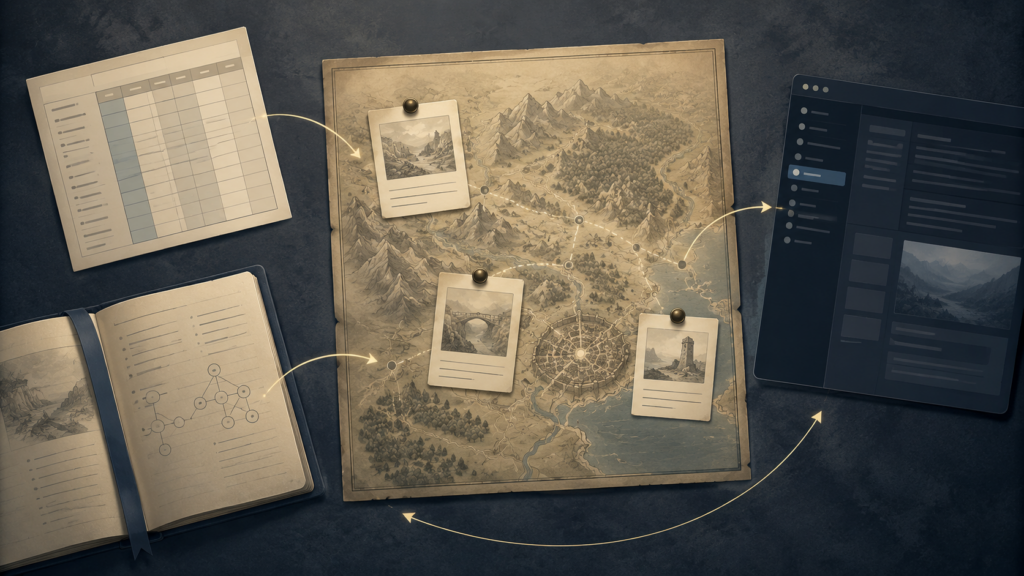
D&D Beyond describes Scene Prep as a way to organize information around individual scenes and connect that preparation directly to Maps. A Dungeon Master can attach preparation to locations and retrieve it while running the game rather than constantly moving between unrelated documents and applications.
D&D Beyond also recommends keeping that preparation relatively lightweight. Bullet points are encouraged over lengthy prose, and its suggested scene structure is intended as a starting point rather than a rigid methodology.
That philosophy is sensible.
Most Dungeon Masters don’t suffer from a shortage of places where they can write things down.
The bigger problem is retrieving those things while six players are looking at them.
Consider a fairly ordinary modern D&D campaign.
Your NPC notes might be in Notion.
Your monster statistics are on D&D Beyond.
Your tactical map is inside a VTT.
The adventure itself is a PDF.
Your session outline is in Google Docs.
A list of treasure is sitting in a spreadsheet.
And the name of the bartender the players unexpectedly decided was their favorite NPC is buried somewhere in notes from three sessions ago.
Every one of those systems might work perfectly well independently.
The problem appears when the DM needs to move between them during play.
Scene Prep tries to shorten that distance.
When the characters arrive at the ruined chapel, the preparation for the ruined chapel can be attached to the ruined chapel.
When they enter the crypt, the crypt notes are there.
When they visit the merchant, the shop information can be there.
That sounds almost trivial.
In practice, it addresses one of the least glamorous but most important parts of Dungeon Mastering:
information retrieval under pressure.
Not Every DM Prep Tool Solves the Same Problem
One mistake we often make when discussing Dungeon Master software is asking which tool is “best.”
That isn’t particularly useful.
Different tools address different layers of preparation.
A preparation methodology such as the Lazy Dungeon Master approach primarily helps answer:
What should I prepare?
The method encourages DMs to concentrate on a relatively small collection of useful material rather than attempting to predict everything that might happen during the session.
That is a preparation philosophy.
You could execute it in Notion, Word, Google Docs, a notebook, index cards, or the back of an envelope.
A dedicated campaign-management tool such as Myth Meister approaches the problem from another direction.
Its D&D session prep system brings campaign information, NPCs, encounters, maps, notes, session material, and other resources together within a more centralized environment.
That answers a different question:
Where does my campaign live?
Flexible knowledge-management systems such as Notion, Obsidian, or RPG-specific campaign databases solve yet another problem:
How do I organize everything I know about this world?
Those tools become increasingly valuable as campaigns grow. Recurring NPCs, factions, locations, histories, unresolved plots, character relationships, and old session notes quickly become too complicated to manage through memory alone.
Scene Prep operates at a smaller level.
Its question is:
What does the DM need right now?
That makes it less of a campaign-management system and more of an execution tool.
And that may be precisely where its value lies.
Think of DM Prep as Three Layers
A useful way to think about modern campaign preparation is to separate it into three layers.
Campaign-Level Preparation
This is the long-term memory of the campaign:
- factions
- recurring NPCs
- character arcs
- locations
- history
- relationships
- long-term villains
- unresolved plots
A campaign wiki, database, Notion workspace, Obsidian vault, dedicated campaign manager, or traditional campaign binder is very good at storing this information.
Session-Level Preparation
This is the material most likely to matter tonight:
- what changed last session
- what important NPCs are doing
- possible scenes
- secrets and clues
- likely encounters
- rewards
- consequences of previous decisions
This is where preparation frameworks and session-prep tools become particularly useful.
Scene-Level Preparation
This is what the Dungeon Master needs to run the specific situation currently happening:
- NPC motivations
- monster statistics
- environmental features
- clues
- treasure
- traps
- descriptions
- tactical considerations
- likely consequences
This is the layer where Scene Prep becomes interesting.
A mature DM workflow may therefore use several tools rather than trying to force one application to do everything.
That isn’t necessarily inefficiency.
Specialized tools can be better than general ones.
The problem begins when those specialized tools refuse to communicate with one another.
A Good DM Tool Should Let You Leave
This is where I have a larger concern about Scene Prep—and about many modern Dungeon Master tools.
Can I get my information back out?
A Dungeon Master may spend hundreds or thousands of hours developing a campaign.
We create locations.
NPCs.
Encounters.
Histories.
Faction relationships.
Scene descriptions.
Treasure.
Adventure structures.
Session records.
Entire worlds.
That information is not merely “data” in the technical sense.
It is the accumulated institutional memory of the campaign.
If the only practical way to create, modify, and consume that information is inside one company’s application, convenience gradually becomes dependency.
That is a walled garden.
The D&D Beyond Scene Prep announcement explains how Dungeon Masters can create and use preparation inside its system.
What is conspicuously absent from this kind of workflow is a robust method for treating Dungeon Master-created information as portable structured data.
And I think portability needs to become one of the standards by which we judge every serious Dungeon Master tool.
The Best Tool for Running a Game Isn’t Necessarily the Best Tool for Creating It
This is particularly important because specialized software already exists for almost every type of creative work a Dungeon Master performs.
Spreadsheets are extraordinarily good at manipulating structured information.
Word processors are better for extended writing.
Database tools are better for managing hundreds of records.
Notion and Obsidian are excellent at interconnected notes.
AI tools are increasingly capable of reorganizing, tagging, summarizing, analyzing, and transforming information.
Virtual tabletops are excellent at presenting encounters during play.
There is no reason the same application needs to be the best tool for all of those jobs.
Imagine preparing twenty encounters in a spreadsheet because that is the fastest environment for editing structured information.
Perhaps the spreadsheet contains:
| Scene | Location | NPCs | Monsters | Secrets | Treasure | Notes |
|---|---|---|---|---|---|---|
| Broken Chapel | Ravenmoor | Father Kel | 4 Ghouls | Hidden crypt | Silver reliquary | Bell alerts undead |
| Old Mill | East Road | Mara Venn | — | Smuggling route | 75 gp | Mara knows the captain |
| Crypt Entrance | Graveyard | — | 2 Wights | Family seal opens door | — | DC 15 Investigation |
Why shouldn’t those scenes be importable into whatever campaign-management or VTT system I use?
Then I run the game.
Perhaps I modify several notes during the session.
Why shouldn’t I be able to export that information afterward and return it to my campaign archive?
Next year I might move to another VTT.
The year after that I might discover a campaign-management tool that better suits the way I DM.
The applications should be replaceable.
The campaign data should not be trapped inside them.
Import and Export Should Be Basic Infrastructure
For a tool like Scene Prep, seemingly boring features such as CSV or JSON import and export could ultimately be more powerful than another proprietary editor.
The ideal workflow shouldn’t require me to recreate everything inside D&D Beyond.
It should allow me to create information wherever creation is easiest and consume it wherever running the game is easiest.
Build encounters in a spreadsheet.
Develop descriptions in a writing tool.
Maintain the campaign history in Obsidian.
Use AI to reorganize yesterday’s session notes.
Push tonight’s relevant material into Scene Prep.
Run the game.
Export the resulting updates afterward.
That is an ecosystem.
Without data portability, what looks like an ecosystem from the user’s perspective is actually a collection of islands.
There Is an Important Distinction Between D&D Content and My Content
There is an obvious complication.
D&D Beyond sells access to copyrighted Dungeons & Dragons material.
Wizards of the Coast has entirely legitimate reasons not to provide a simple mechanism that allows someone to purchase a book and immediately export every monster, spell, magic item, illustration, and page of text as structured data.
Content licensing matters.
Copyright matters.
Piracy matters.
But that is not the same problem as exporting Dungeon Master-created information.
There is an important distinction between:
Wizards’ content
and
my campaign data.
The monster stat block Wizards published belongs to Wizards.
The notes I wrote explaining how that monster fits into my campaign are mine.
The published adventure belongs to its publisher.
The NPC I created to connect it to my players’ backstories is mine.
The official description of Waterdeep is commercial D&D content.
The notes explaining that my players accidentally burned down one of its taverns three months ago are campaign data.
A mature platform should be able to protect commercial content while still allowing users to control the information they created themselves.
Those are separate technical and policy problems.
The Business Incentives Get Complicated
As D&D Beyond expands the range of material available at the table, it also reinforces the Dungeon Master’s growing role as curator.
There is also an uncomfortable economic question underneath all of this.
What happens if D&D Beyond eventually offers comprehensive APIs and genuinely portable campaign data?
Third-party developers could build tools that Dungeon Masters prefer to D&D Beyond’s own interfaces.
Someone might build a better encounter planner.
Someone else might build a better campaign manager.
Someone might build a better VTT.
Someone else might build an exceptional AI Dungeon Master assistant.
Suddenly D&D Beyond doesn’t necessarily have to be the place where Dungeon Masters create or manage everything.
It could instead become something potentially even more important:
the infrastructure through which officially licensed D&D content flows into an ecosystem of tools.
There is a compelling argument for that model.
D&D Beyond’s strongest long-term advantage may not be that it can build the best possible interface for every aspect of Dungeon Mastering.
Its advantage is access to the official Dungeons & Dragons ecosystem and an enormous library of structured game content.
An open architecture could make that library more valuable.
Buy a monster book on D&D Beyond and authorized applications could use those monsters.
Buy an adventure and your preferred campaign manager could recognize its locations and NPCs.
Build an encounter somewhere else and your licensed monsters could populate automatically.
Prepare your campaign in whatever tool you prefer and send tonight’s scenes into your VTT.
D&D Beyond becomes infrastructure rather than demanding that it also become the best notebook, spreadsheet, database, campaign manager, encounter planner, and virtual tabletop.
But there is an obvious tension.
A platform benefits when its ecosystem becomes more useful.
A platform may also benefit when customers find it inconvenient to leave.
We shouldn’t automatically interpret the absence of APIs or comprehensive export tools as a deliberate attempt to create lock-in. Public APIs require security, documentation, versioning, support, and substantial engineering resources.
But intent doesn’t change the practical consequence.
If I cannot easily move my campaign information somewhere else, that information is effectively locked into the platform.
Portability Should Become Part of How We Evaluate DM Tools
So when the next Dungeon Master application launches, don’t merely ask:
Does this make preparation easier?
Ask:
Can this work with the rest of my preparation system?
Can I import information?
Can I export it?
Can another application read it?
Can I modify fifty records at once?
Can I automate repetitive work?
Can I connect it to a spreadsheet?
Can I back up what I created?
Can I take my campaign somewhere else if the software disappears, changes direction, increases its price, or simply stops fitting the way I run my game?
Those questions are only going to become more important.
Dungeon Masters routinely run campaigns lasting years. Some of us have campaign worlds whose histories stretch across decades of play.
Moving those campaigns into digital systems creates enormous advantages.
It also creates a responsibility for software developers.
Our campaign should not become collateral for our choice of software.
The Real Trend Is Prep Becoming Playable
That criticism shouldn’t obscure what Scene Prep gets right.
The interesting direction here is that Dungeon Master tools are slowly moving beyond helping us write information down and toward helping us deploy that information during play.
That is a significant improvement.
A notebook stores information.
A database organizes information.
A preparation framework helps determine which information matters.
Scene Prep attempts to present that information in the context where the Dungeon Master will actually use it.
That is exactly where modern DM tooling should be headed.
But the ideal future isn’t one enormous Dungeon Master application containing every piece of the campaign.
It is an ecosystem of specialized tools that can exchange information.
Use the best tool for writing.
Use the best tool for organizing.
Use the best tool for planning.
Use the best tool for running the game.
And allow the information to travel between them.
Scene Prep is interesting because it moves preparation closer to actual play.
The next step is making sure that preparation can move freely as well.
Because ultimately, the software isn’t the valuable part.
The campaign is.
Discover more from The Stygian Labyrinth
Subscribe to get the latest posts sent to your email.
1 thought on “D&D Beyond Scene Prep and the Future of DM Preparation”